Copy
View this email in your browser
About SIRIUS

Despite the polarization in public and policy debates generated by the post-2014 fluxes of refugees, asylum applicants and migrants, European countries need to work out an evidence-based way to deal with migration and asylum rather than a prejudice-based one. The project, SIRIUS, builds on a multi-dimensional conceptual framework in which host country or political-institutional, societal and individual-related conditions function either as enablers or as barriers to migrants’, refugees’ and asylum seekers’ integration via the labour market. 

The first SIRIUS Newsletter

Although the project has only been running for six months, we have managed to have two consortium meetings, two public events on Labour Market and Migration, and organised a flash mob (see link below)!

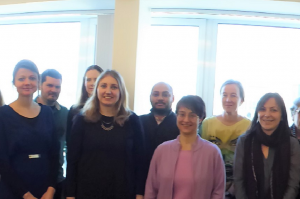
SIRIUS Second Consortium Meeting and Public Event
SIRIUS First Consortium Meeting and Public Event
Flash Mob brings happiness and solidarity

Work Package 1

The aim of WP1 is to investigate labour shortages, skills needs and mismatches by examining skills and qualifications and their use in the labour market so as to assess the position of post-2014 migrants, refugees, asylum seekers in the workforce and identify barriers and enablers for their labour market integration.

Partners are investigating the position of post-2014 migrants, refugees, asylum seekers in the workforce for all the SIRIUS countries (United Kingdom, Switzerland, Italy, Czech Republic, Denmark, Greece and Finland) to build a comprehensive assessment of labour market barriers and enablers. This work phase involves conducting cross-national comparative research at two levels. At the first level, the research focuses on the characteristics (skills and qualifications) of recent migrants, refugees, asylum seekers in each country under investigation, in order to evaluate the integration progress and determine the drivers behind unemployment and inactivity. At the second level, the research focuses on specific features of each country in our study, including: productive structure, employment composition by sector of economic activity, occupations and skills, labour flows, unemployment rates, level of skills as well as the overall macroeconomic situation. The scope of this level is to identify the key sectors for output and employment as well as the dynamic occupations of the current period and to forecast the future trends in these areas.

An efficient model for the simulation of the labour market will be achieved, providing a method for the matching of skills and qualifications of migrants, refugees and asylum seekers across the sectors and the occupations of the economy, aiming for the optimization of the integration process.

Work Package 2

WP2 will contribute to revealing how, and to what extent, the legal and institutional regimes and the socio-cultural environments of the countries which are the focus of our research have a (beneficial or negative) impact on the effective capacity of those countries to integrate migrants, refugees and asylum seekers into the labour market. Through the analysis of the different legal status, rights, duties, entitlements of migrants, refugees and asylum seekers, WP2 will clearly highlight differences and similarities in the legal regimes concerning migrants, refugees and asylum seekers. Furthermore, the triangulation of legal analysis and sociocultural data organized in a structured data-set will allow us to investigate the interrelation between socio-cultural perceptions and determinants, and legal regimes. Understanding these complex mechanisms will establish the foundations for a more informed analysis in the subsequent WPs.

Thus, this WP will focus on the analysis of: the constitutional and legal structure of the country (the constitutional entrenchment of the principle of asylum, decentralization, the powers and functions of sub-national institutions, the system of government, horizontal and vertical subsidiarity, systems of judicial enforcement and the vindication of rights, independence the and role of the judiciary; the process of national compliance with international conventions and treaties, and EU legislation on migration, refugee and asylum, with special attention to labour related rights; the specific migration, asylum and refugee legislation; the migrants and asylum seekers/refugees crisis-driven reforms; and a sample of the relevant case-law, with special attention to the use of the courts by citizens as a terrain to resist legislation and regulation which may harm them.

Specific research will be devoted to the scrutiny of the legal framework of the European Union, to the current Common European Asylum System (CEAS), and its cornerstone, the Dublin System, and to the Legal Migration framework (the Single Permit Directive (Directive 2011/98/EU); the sector-oriented directives on Highly Qualified Employment- better known as the EU Blue Card Directive (Directive 2009/50/EC), the Seasonal Employment (Directive 2014/36/EU), and the Intra Corporate Transferees (Directive 2014/66/EU); as well as the relevant case-law at both the level of the European Court of Justice and of the European Court of Human Rights.

Copyright © 2018 SIRIUS, All rights reserved.


Want to change how you receive these emails?
You can update your preferences or unsubscribe from this list.

Email Marketing Powered by Mailchimp